
A buyer decodes a Sprinter VIN and sees 2025. The sales listing calls the completed luxury van a 2026. Is that automatically wrong?
No. Many luxury passenger vans are multistage vehicles. Mercedes-Benz builds an incomplete chassis or van, and a final-stage manufacturer completes the passenger conversion later. The chassis year, final completion date and titled model year can therefore describe different parts of the same manufacturing story. The right response is not to dismiss the van—or accept a verbal explanation. It is to reconcile the documents.
The four records buyers should separate
| Record | What it tells you | What it does not prove |
|---|---|---|
| 17-character VIN | Identity assigned to the chassis; position 10 encodes model year | The final conversion’s equipment or completion date |
| Incomplete-vehicle label/document | Chassis manufacturer, VIN, weight ratings and certification instructions | That the conversion was completed correctly |
| Final-stage certification label | Who completed the vehicle and when, plus completed-vehicle certification data | The start date of every warranty |
| State title/MSO packet | How the jurisdiction recorded make, model and year | The condition or exact options of the van |
The NHTSA VIN decoder is the correct public tool for checking the full VIN. NHTSA’s manufacturer handbook explains that VIN position 10 encodes the vehicle model year and that the model year is the manufacturer’s designation—not necessarily the calendar year in which production occurred.
Why the years can differ
NHTSA defines a final-stage manufacturer as the company that performs the work required to turn an incomplete vehicle into a completed vehicle. Its manufacturer requirements handbook says the incomplete-vehicle manufacturer supplies certification information, while the final-stage manufacturer assumes responsibility for certification-related duties involving the components and systems it installs.
A simplified sequence can look like this:
- Mercedes-Benz assigns a VIN and chassis model year.
- The chassis is delivered to an upfitter.
- The upfitter installs seating, electrical systems, cabinetry, HVAC and other equipment.
- The upfitter affixes its final-stage certification label.
- The completed vehicle is sold and titled under the applicable state process.
That is why a 2025 VIN decode can coexist with a later conversion completion. It is not permission to call every older chassis a newer van. The final-stage paperwork must support the completed-vehicle identity.
Alabama’s rule is unusually clear
For vehicles titled in Alabama, Alabama Administrative Rule 810-5-75-.58 addresses multistage vehicles directly. When separate manufacturers’ statements of origin are furnished for the chassis and body, all statements must be submitted. The title reflects the chassis VIN and the make, model and year of the body.
That is valuable guidance for an Alabama buyer, but it should not be generalized to every state. A buyer registering elsewhere should ask that state’s motor-vehicle agency how it records a multistage passenger van before money changes hands.
The six-step paperwork check
1. Decode the full VIN
Use NHTSA’s decoder, not a screenshot or a seller’s typed summary. Confirm the make, model-year result, plant and vehicle type. A VIN result is the chassis starting point.
2. Photograph both certification labels
Look for the chassis/incomplete-vehicle label and the final-stage manufacturer’s label. Photograph them in focus. The final-stage label should identify the completing manufacturer and certification information. Do not rely on a loose label in a folder.
3. Match the title and MSOs
The VIN on the title must match the dashboard, door label and paperwork. For a multistage vehicle, request every relevant manufacturer’s statement of origin when it has not yet been titled. For a used vehicle, review the current title and prior registration history.
4. Separate warranty clocks
Mercedes-Benz publishes model-specific service and warranty booklets through its owner-manual library. Its general warranty page lists a 3-year/36,000-mile basic limited warranty and a 5-year/100,000-mile Sprinter powertrain limited warranty, but exact coverage depends on the booklet, in-service date, mileage and exclusions.
The conversion has a separate warranty. Chairs, shades, plumbing, cabin electronics and auxiliary HVAC may be covered by the upfitter or component supplier rather than Mercedes-Benz. Ask for written terms and verify who authorizes repairs.
5. Check recalls by VIN
Use the NHTSA recall lookup for the actual VIN. Model-year assumptions are not enough. A recall may apply to the chassis while a conversion issue belongs to the upfitter.
6. Put the year explanation in the deal file
The buyer’s order, title application, insurance binder and lender description should not contradict one another. If the listing uses the completed-vehicle year, keep the documentation that supports it. If a lender or insurer calls the van by the chassis year, resolve that before delivery.
What this means for pricing and resale
A newer completed-vehicle year can affect search filters and valuation guides, while the chassis year matters for parts, service campaigns and VIN-based history. Neither number replaces condition.
Compare the chassis model year and drivetrain, conversion completion date, mileage and in-service date, written chassis and conversion warranty, maintenance records, installed equipment and title history. A buyer should not pay more solely because a listing headline shows a newer year. The value lies in the complete, documented vehicle.
A clean explanation for a buyer
This luxury van was built in more than one stage. Mercedes-Benz produced the chassis first, and the final-stage manufacturer completed the passenger conversion later. The VIN identifies the chassis; the final-stage label and title documents identify the completed vehicle. We will provide the labels and paperwork so you can verify both.
That is stronger than saying “RVs are just different.” It gives the buyer records they can check.
For additional diligence, read our used luxury Sprinter warranty guide and VIN-specific recall checklist.
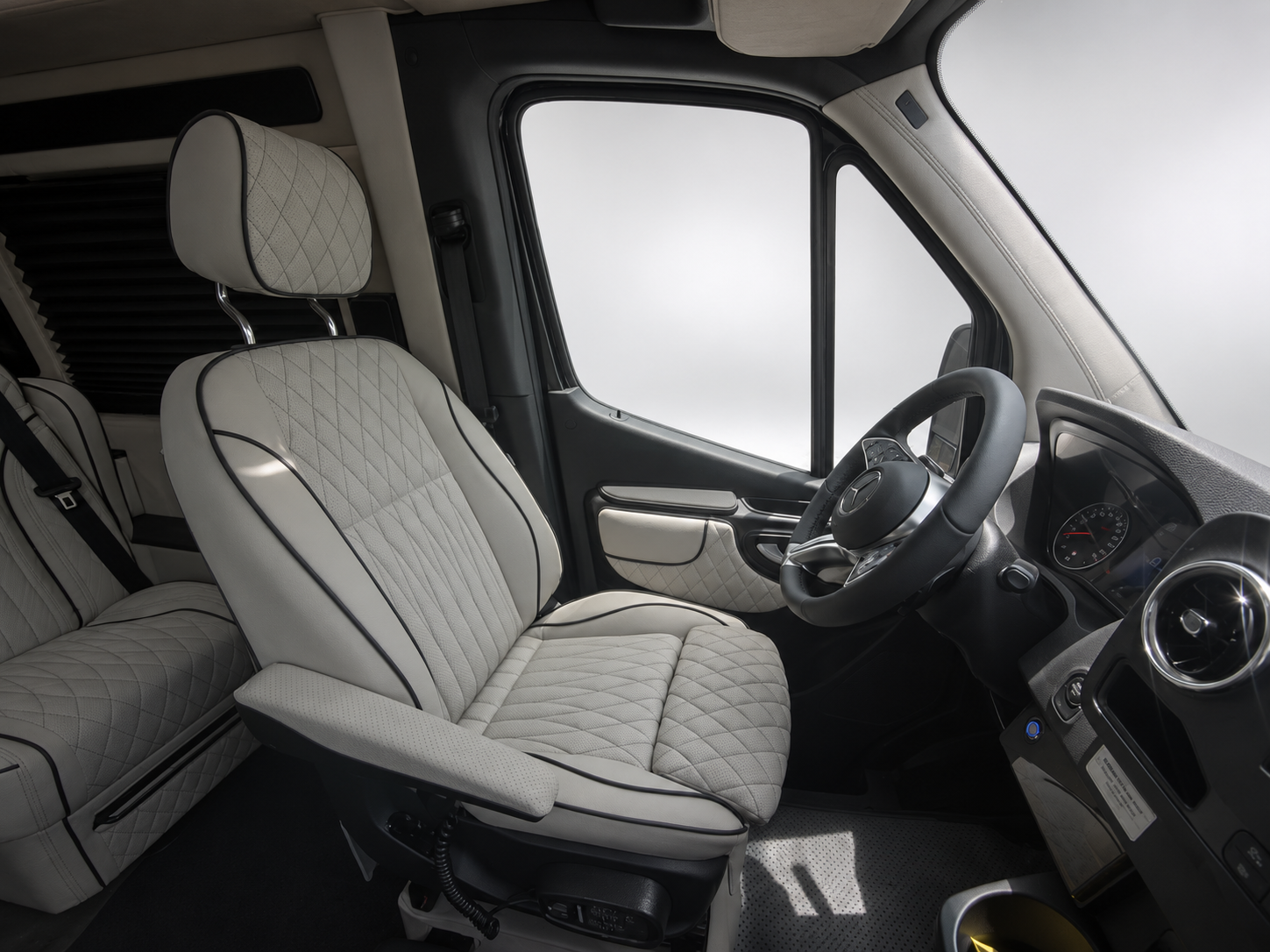
Hero-image note: Dufourfun Vans business-owned inventory photograph from the 2026 Midwest G55 listing; original business asset. Creator name is not recorded. Used with business authorization; no third-party attribution required. The photograph illustrates a Sprinter cockpit and does not establish the year of any vehicle discussed.
Verify the records before choosing the cabin
View Vans for Sale and ask for the VIN, title status and certification labels on the exact unit. If the ideal layout is not available, Build Your Custom Van with the documentation plan included from the start.