
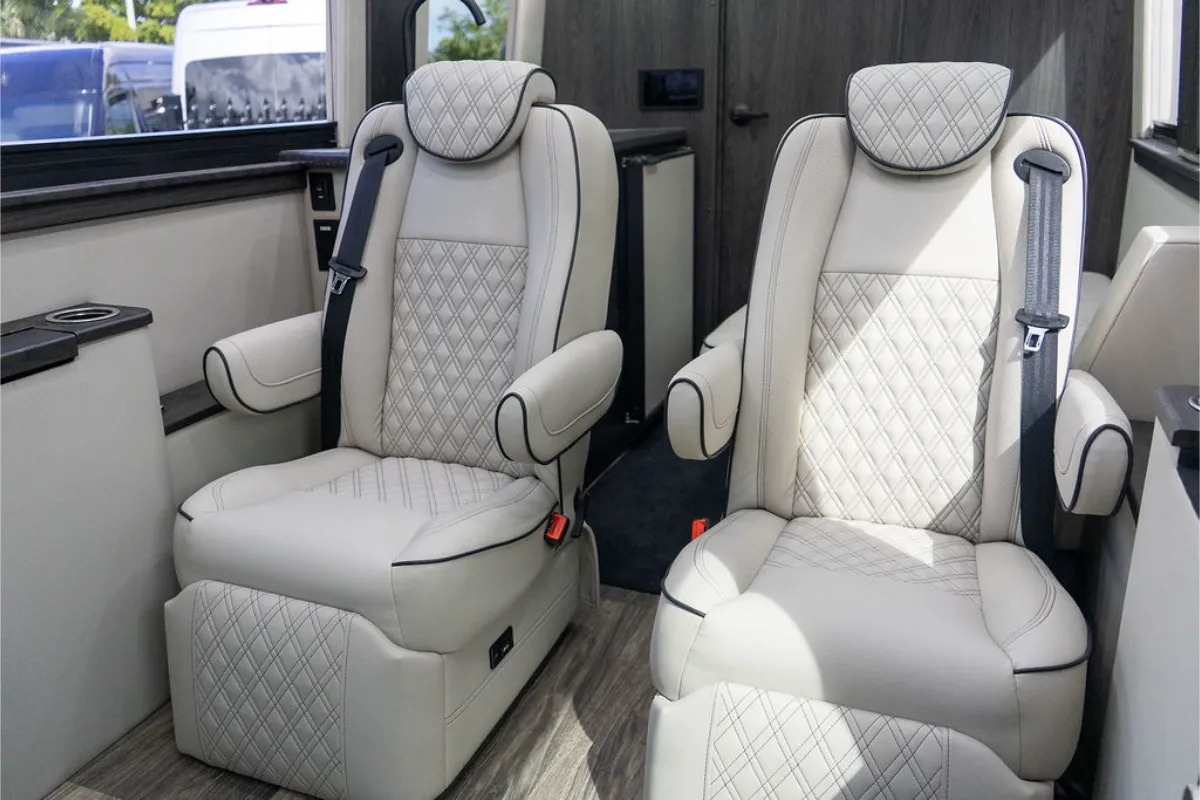
The newest inventory question is not simply whether a van has AWD. It is whether the entire completed vehicle—seats, bathroom, power system, storage and documentation—fits the trips a buyer will repeat.
As of November 18, 2026, Dufourfun Vans lists this 2025 OGV AWD Family Van at $185,400 with 500 recorded miles, ten seats and four premium captain’s chairs. Availability, price and mileage can change, so verify them again before relying on this snapshot.
What the current listing confirms
| Listing field | Recorded detail |
|---|---|
| Model year | 2025 |
| Upfitter/model | OGV Luxury Coach AWD Family Van |
| Asking price | $185,400 |
| Recorded mileage | 500 |
| Exterior | Silver |
| Listed interior | Cream; description identifies Stone Gray seating and Black Oak cabinetry |
| Seat count | 10 |
| Premium captain’s chairs | 4 |
| Platform | Extended 170-inch Mercedes-Benz Sprinter |
| Cabin plan | Front partition, captain’s chairs, opposing benches and three folding lap trays |
| Rear amenity | Bathroom with toilet and hand-sanitizer station |
| House power | 100Ah lithium battery, 2,000-watt inverter/charge controller and 30-amp shore power |
| Status at publication | Available |
These are inventory-record facts, not a factory brochure for every OGV. Confirm the window sticker, build sheet, labels and installed equipment on the exact van.
1. Decide whether ten seats are the right ten seats
A ten-seat cabin sounds flexible, but the important question is how the group uses those positions. The listing records four premium captain’s chairs plus opposing benches. During inspection, identify every designated travel seat and belt. Sit in each position, buckle in and confirm that tables and leg lifts stow safely.
Then load the real luggage. A rear bathroom, partition and benches all claim interior volume. The design may be ideal for comfortable day travel and still require disciplined packing for ten people.
A useful test is three scenarios:
- Four adults with large luggage.
- Six adults with weekend bags.
- The full intended group with the exact mix of bags, mobility items, golf clubs or sports gear.
Do not average those cases. The most demanding repeat trip should drive the decision.
2. Treat the bathroom as a space trade, not a free bonus
The listed rear bathroom can reduce unscheduled stops and add privacy on long days. It also occupies the part of a van many buyers use for luggage. Open every cabinet and door with the cabin fully occupied. Check whether the bathroom remains usable after bags are loaded and whether ventilation, cleaning access and winterization instructions are documented.
Ask who warrants each bathroom component and where service is performed. The Mercedes-Benz chassis warranty does not automatically answer an upfit-system question.
3. Verify the completed-vehicle payload
Mercedes publishes base Sprinter specifications, but a luxury conversion adds substantial equipment. The exact completed vehicle’s certification and capacity labels matter more than a cargo-van web page.
Use the correct Mercedes-Benz Sprinter owner manual, then read the van’s own labels. Add the actual people, luggage, water, accessories and any hitch load. If the intended group approaches the limit, weigh the loaded van by axle.
This also protects the buyer from a common mistake: assuming that ten seat belts guarantee useful luggage capacity for ten adults. They do not.
4. Understand what AWD changes—and what it does not
AWD can improve traction when starting or climbing on a low-traction surface. It does not override tire limits, create more payload, shorten braking distances or make a tall vehicle immune to wind and ice.
This listing also describes 16-inch black wheels, all-terrain tires and SumoSprings. Verify tire age, size, load rating and recommended cold pressures on the exact vehicle. Ask for alignment and ride-height documentation if suspension components were added. Drive on ordinary pavement as well as the type of road that motivated the AWD choice.
For upfit questions, Mercedes publishes current Sprinter Body and Equipment Guidelines. Those guidelines do not certify this exact conversion for you; they show why written upfit documentation matters.
5. Test the electrical system under a real load
The listing records a 100Ah lithium battery, 2,000-watt inverter with charge controller, 110-volt outlets and a 30-amp shore-power connection. That is a system description, not a promise of unlimited runtime.
Ask the seller to demonstrate:
- Battery state of charge before the test.
- Rear HVAC behavior while parked and while driving.
- Shore-power connection and charging.
- The outlets with the appliances you actually plan to use.
- Touchscreen control after the vehicle has been shut down and restarted.
- Location of breakers, fuses, disconnects and service access.
- Written manuals for the battery, inverter, charger and other installed equipment.
Record what runs from the house battery, what requires shore power and what depends on the engine. A verbal walk-through is easy to forget.
6. Split the warranty into two columns
Mercedes-Benz publishes the chassis warranty and maintenance overview, including model-year service and warranty documents. A converted van can also have separate upfitter and component coverage.
Get these answers in writing:
| Chassis questions | Conversion questions |
|---|---|
| In-service date and remaining coverage | Upfitter warranty start and end dates |
| Open recalls or campaigns | Coverage for seats, electronics, bathroom and cabinetry |
| Authorized Mercedes service history | Authorized conversion service locations |
| Required maintenance records | Transferability to a later owner |
| Coverage effect of installed equipment | Labor, travel and diagnostic responsibilities |
Do not assume that “factory warranty” describes the whole van.
7. Complete the pre-purchase drive and document check
Before purchase:
- Verify VIN, title status, model-year paperwork and whether the 500 miles are still current.
- Read the completed-vehicle labels and photograph them.
- Request chassis and upfit build sheets.
- Test every designated seat, belt, table, leg lift, cabinet and latch.
- Run the electrical demonstration.
- Inspect bathroom operation and service access.
- Drive at city and highway speeds, listening for rattles and checking rear visibility.
- Confirm overall height and length against home storage and regular parking.
- Get all promised repairs, accessories and warranty statements in writing.
For a very low-mileage current-model vehicle, the buyer should also ask how it was used, stored and titled. Low mileage is useful information, but it does not replace an inspection.
Who this OGV fits best
This layout deserves attention from families and business owners who want a separated passenger lounge, individual premium seats, rear-cabin amenities and AWD for recurring travel. It is less obvious for buyers who need maximum rear luggage volume, an open social connection to the driver or the simplest possible systems.
Compare it with current inventory, not a remembered brochure. View Vans for Sale to see what is actually available. If ten seats, the partition or rear bathroom is the wrong combination, Build Your Custom Van around the passenger and luggage plan first.
Hero photo source and usage: Dufourfun Vans 2025 OGV AWD Family Van inventory, stored in the business’s public inventory bucket. Creator is not recorded. Usage basis is a business-owned marketing asset. The image shows the exact listed captain’s-chair cabin.