
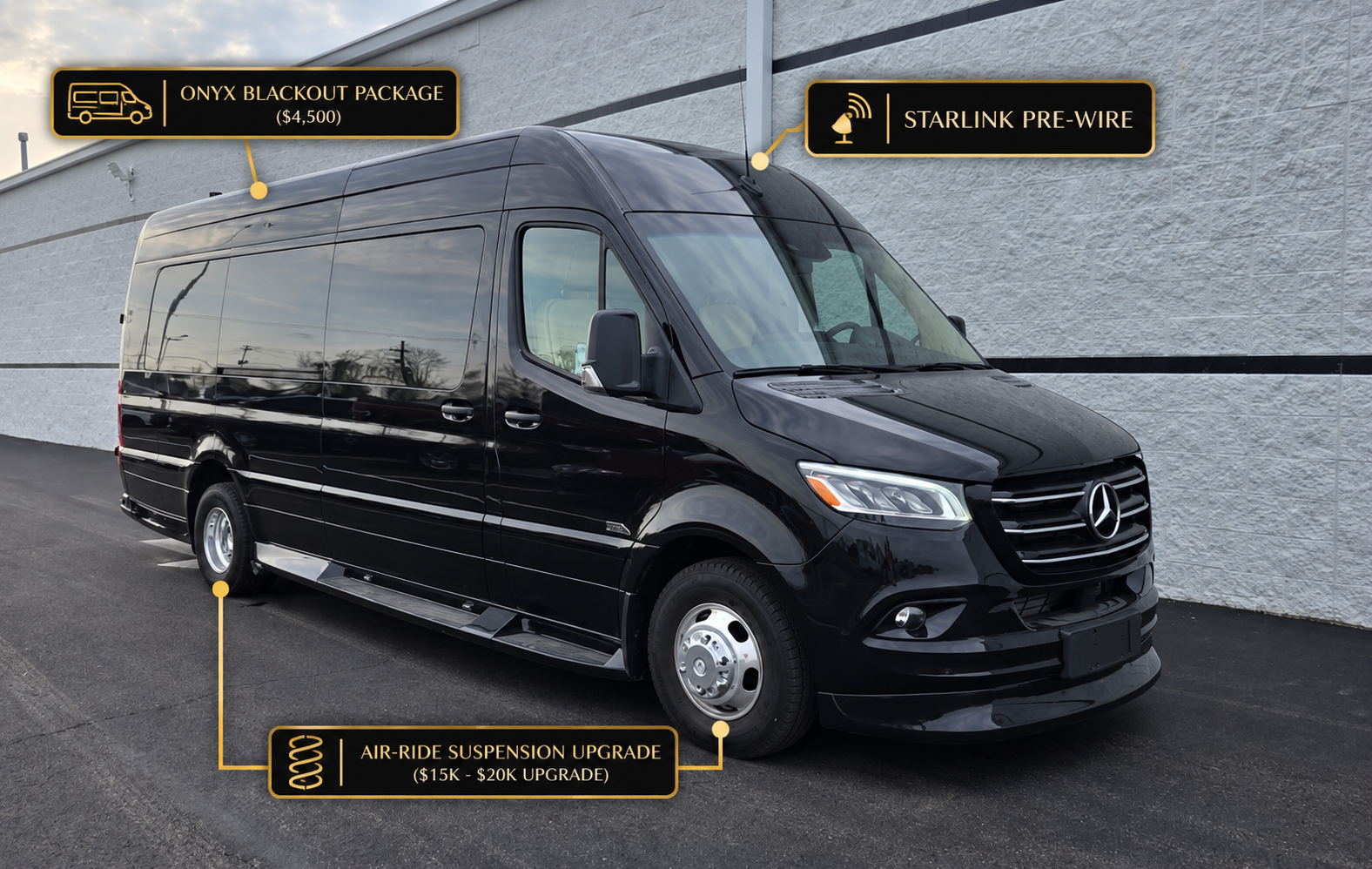
Two current Midwest Automotive Designs Luxe Cruiser listings put a real number on a familiar buyer question: how much should you pay for a newer conversion with fewer miles?
As of November 25, 2026, Dufourfun Vans lists a 2025 Midwest Luxe Cruiser at $155,100 with 15,900 miles and a 2026 Midwest Luxe Cruiser at $184,900 with 1,900 miles in the structured inventory field. That is a $29,800 price difference and a 14,000-mile difference.
Prices, mileage and availability can change. This is a comparison of the records observed on that date, not a promise that either van remains available or that the lower-mile van is automatically the better purchase.
The verified snapshot
| Item | 2025 Luxe Cruiser | 2026 Luxe Cruiser |
|---|---|---|
| Listed price | $155,100 | $184,900 |
| Structured mileage field | 15,900 | 1,900 |
| Price difference | — | $29,800 more |
| Mileage difference | 14,000 more | — |
| Interior/equipment evidence in listing | Limited; verify exact build sheet | Black interior, 10 seats, four premium captain chairs, air ride, Onyx Blackout package, Starlink pre-wire |
| Important record issue | Confirm full equipment and history | Narrative says 900 miles while structured field says 1,900; resolve before purchase |
The 2026 mileage conflict is not a small editorial detail. Ask the seller to confirm the odometer, title disclosure and listing record in writing before using the number for valuation or financing.
1. Do not price the model name alone
The official Midwest Luxe Cruiser page describes the model family as an open-floor-plan luxury touring van and shows equipment that may be available. It does not prove that every Luxe Cruiser has the same seats, electrical system, suspension or entertainment package.
For the 2025 listing, the current database verifies the model, year, price and mileage but does not provide a comparable feature list. Do not borrow the 2026 van’s features to fill that gap. Request both original build sheets, window stickers or invoices, equipment serial numbers and current photos.
For the 2026 van, the listing specifically describes:
- ten seats;
- four premium captain chairs;
- air-ride suspension;
- an Onyx Blackout package;
- Starlink pre-wire.
“Pre-wire” means preparation, not necessarily Starlink hardware, activation or service. Verify what is physically installed and whether any subscription is included.
2. Put the $29,800 difference into the financing conversation
The price gap is not the same as the payment gap. Down payment, term, interest rate, taxes and fees all matter. A simple principal-only illustration shows scale: $29,800 divided over 60 months is about $497 per month before interest, taxes or fees. That is not a loan quote.
Ask lenders to quote both VINs with the same down payment and term. Specialty conversions can be titled or valued differently, so confirm whether the lender sees the unit as a passenger vehicle, recreational vehicle or another completed-vehicle type. Compare total interest and total cash paid, not just the monthly number.
3. Treat mileage as evidence, not a verdict
Fourteen thousand miles can matter, but condition and service history can matter more. A carefully maintained 15,900-mile van may be preferable to a lower-mile van with long storage, incomplete service or unresolved conversion issues.
For each van, request:
- chassis and conversion service records;
- tire date codes and tread measurements;
- brake and suspension inspection results;
- battery and charging-system testing;
- generator or auxiliary-power hours, if equipped;
- evidence that every seat, shade, door, screen and climate zone works;
- a professional pre-purchase inspection that covers both chassis and conversion.
Drive both on the same mix of roads. Listen for cabinet movement, trim noise and suspension behavior. Test rear climate at idle and underway. A feature list cannot substitute for that comparison.
4. Understand the three clocks: chassis year, conversion year and in-service date
Luxury conversions can involve a chassis model year, a completed-vehicle model year and a first retail or in-service date. Those dates affect title documents, resale comparisons and warranty analysis. Match the VIN, title, completed-vehicle label and upfitter paperwork.
Mercedes-Benz says its Sprinter basic limited warranty is 3 years or 36,000 miles and powertrain coverage is 5 years or 100,000 miles, but coverage begins from the applicable in-service terms and exclusions apply. The 2026 Sprinter warranty booklet also makes clear that upfit and conversion equipment is not Mercedes-Benz chassis coverage.
Midwest’s current warranty page says coverage depends on model year, use, mileage, ownership, maintenance and component terms. A published 2025 Midwest warranty document describes limited original-owner coverage and separate structural terms. Do not assume either used listing has transferable or remaining coverage. Obtain written confirmation for the exact unit.
5. Decide what the newer van actually buys
The 2026 asking price may buy more than lower mileage if its documented equipment, condition and remaining coverage are better. But it may also include features the buyer does not need.
| Buyer priority | Stronger initial case | Why |
|---|---|---|
| Lowest acquisition price | 2025 | $29,800 lower asking price |
| Lowest listed mileage | 2026 | 14,000 fewer miles in the structured field |
| Verified 10-seat layout | 2026 | Listing documents ten seats |
| Known air-ride equipment | 2026 | Listing specifically identifies air ride |
| Best value after inspection | Undetermined | Requires matched build sheets, history and condition |
| Least record ambiguity | Undetermined | 2026 mileage conflict must be corrected; 2025 equipment detail is incomplete |
Neither listing wins on the current records alone.
6. Inspect the conversion like a second vehicle
A converted Sprinter has two service ecosystems. Mercedes-Benz services the chassis within its responsibilities; the upfitter or component maker may be responsible for cabinetry, seats, electrical systems, climate add-ons, entertainment and other conversion work.
Use Midwest’s construction overview to understand the types of systems the builder integrates, then compare that overview to the exact completed vans. Ask where the nearest qualified service is, what diagnostic information is available and whether replacement components remain supported.
Also verify payload. Ten seats do not mean ten adults plus unlimited luggage. Use the completed-vehicle labels and actual loading plan to confirm occupant and cargo capacity.
The questions to answer before choosing
For the 2025:
- What is the complete equipment list?
- Who owned it, how was it used and why are service records complete or incomplete?
- What conversion coverage, if any, transfers?
- What maintenance is due by time as well as mileage?
For the 2026:
- Is the correct mileage 900 or 1,900?
- What does Starlink pre-wire include physically?
- Which air-ride system is installed, and who services it?
- When did chassis and conversion warranties begin?
- Does the title and completed-vehicle paperwork match the advertised year?
For both:
- What does an independent inspection find?
- Are there open recalls or campaigns for the VIN?
- Do all belted seats and conversion systems operate as documented?
- What is the out-the-door price and total financing cost?
Bottom line
The 2025 van starts with a $29,800 price advantage. The 2026 starts with 14,000 fewer listed miles and a more detailed equipment record. The correct choice depends on verified condition, exact build, warranty status and the buyer’s real passenger plan—not on year or mileage alone.
View Vans for Sale to review current listings and availability. If neither layout matches the way you travel, Build Your Custom Van and specify seating, storage, suspension and technology from the start.
Hero image source: 2026 Midwest Luxe Cruiser listing. Creator: Dufourfun Vans or its commissioned listing photographer. Usage basis: business-owned listing media. Required attribution: none.