
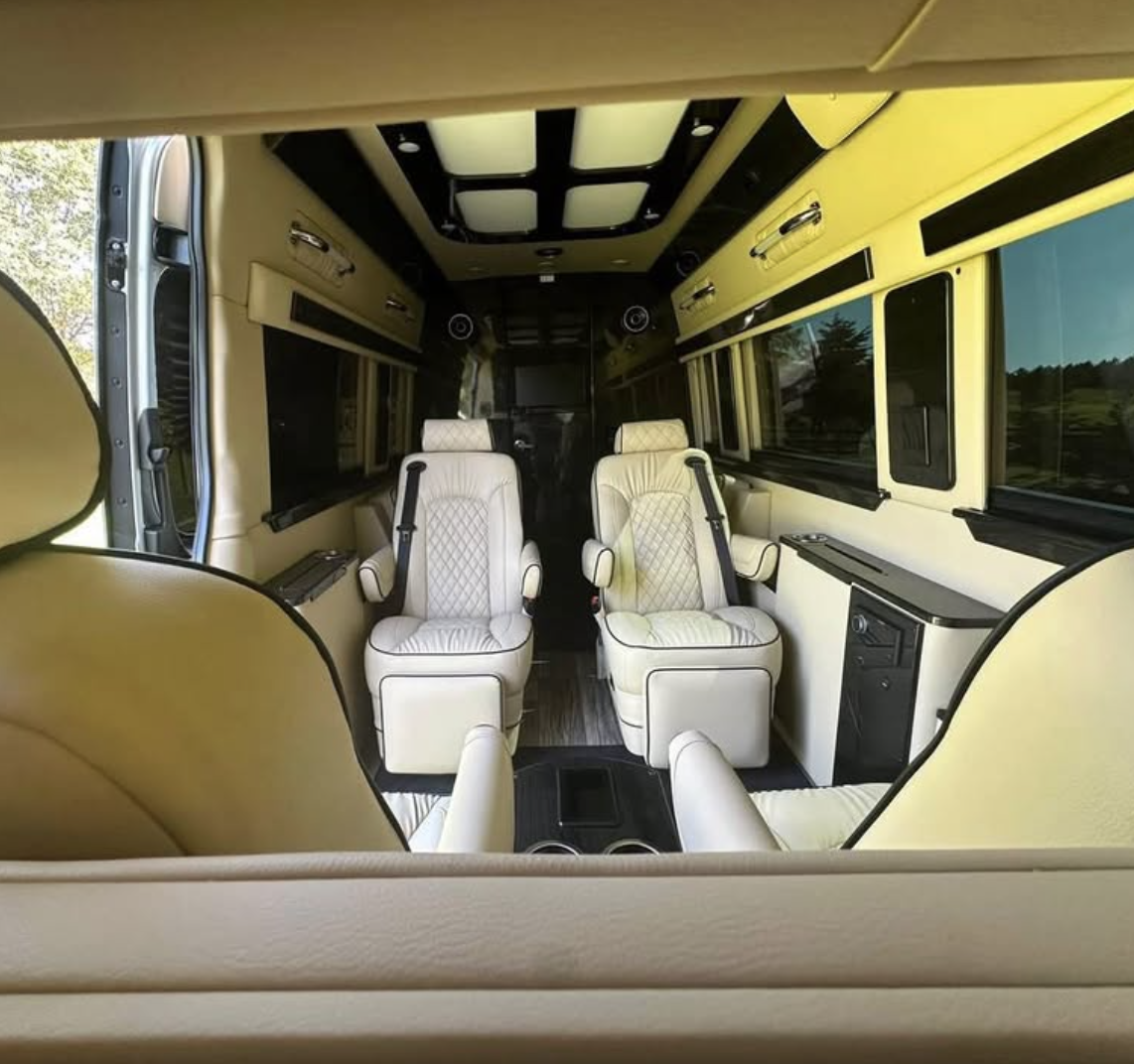
Dance competition travel exposes weaknesses that a showroom walkaround can hide. A family may carry dancers, siblings, garment bags, makeup cases, food, folding items and normal weekend luggage—then repeat the routine several times a season.
The useful question is not “How luxurious is the cabin?” It is “Can everyone ride correctly restrained while the costumes and bags stay organized?”
Hero image: Dufourfun Vans-owned inventory photography of a specific Executive Coach cabin. Use it as a layout example only; equipment and seating vary by vehicle.
1. Start with restraints, not reclining features
Write down every regular traveler’s age and size before shopping. NHTSA’s car-seat and booster guidance says buyers should follow both the child-restraint instructions and the vehicle owner’s manual, including the availability of lower anchors and tethers. Many children ages 8–12 still need a booster until an adult belt fits properly.
For each candidate van, verify:
- a designated belted seating position for every person;
- lap-and-shoulder belt geometry at the seats your children will use;
- documented lower-anchor and tether locations when a child restraint needs them;
- enough space to install the actual restraint without blocking the aisle;
- a seating arrangement that keeps children correctly buckled throughout the drive.
A captain’s chair is not automatically a child-seat-compatible chair. Test the real seat before purchase.
2. Perform a garment-bag load test
Bring representative gear to the inspection. Load the longest garment bag, rolling case, shoe bag, weekend suitcase and cooler. Then close every door and seat every passenger.
NHTSA’s cargo-securement advice is simple: tie down cargo and do not overload the vehicle. In a passenger van, that means costumes should not hang where they obscure the driver’s view, interfere with a belt or become loose cabin cargo.
A useful storage plan separates four zones:
| Zone | Best use | Buyer check |
|---|---|---|
| Immediate-access bin | Hair, makeup, snacks, medications | Reachable without unbuckling |
| Hanging zone | Costumes and jackets | Fixed rail or secured hooks, away from exits |
| Rear luggage zone | Suitcases and folding gear | Bags can be restrained and rear doors still open |
| Dirty-item zone | Shoes, wet towels, used costumes | Washable container isolated from clean garments |
If every stop requires unloading the aisle, the floor plan is wrong.
3. Protect the boarding path
Competition mornings are rushed. A narrow aisle, high step or loose bags create friction on every hotel and venue stop. Open the sliding door and rehearse boarding with the largest costume case in hand.
Look for a clear path from the door to each seat, stable entry steps, grab handles and lighting that works before sunrise. A visually impressive galley or console may be a bad trade if it pinches the path used ten times a day.
4. Compare usable capacity, not advertised capacity
Current luxury converters illustrate why model names alone are insufficient. Ultimate Toys says the current Ultimate Coach can seat up to ten in its standard configuration, while other Coach layouts have different capacities. Midwest Automotive Designs markets several executive and athletic Sprinter layouts with different seating and equipment-storage priorities.
Those manufacturer pages are starting points, not proof of a used van’s configuration. Confirm the actual VIN, certification labels, seat installation, floor plan and options on the vehicle you are buying.
5. Check payload with the family aboard
The combined weight of occupants and cargo must stay within the vehicle’s rated capacity. Find the Tire and Loading Information label at the driver’s door area and compare it with your realistic passenger-and-bag estimate. NHTSA’s TireWise guidance explains where to find the correct tire and loading information.
Do not assume a long van has unlimited payload. Luxury interiors, water systems, batteries and accessories all consume capacity before the first suitcase is loaded.
6. Buy for the return drive
The ride home is the honest test: tired passengers, used costumes, low batteries and late-night miles. Test rear climate control, reading lights, device charging and cabin noise at highway speed. Ask whether the driver can control or override screens and lighting without distraction.
A restroom may be valuable for certain families, but it reduces space and adds water-system maintenance. A partition may create privacy, but it can make parent-child communication harder. Every luxury feature has a floor-plan cost.
A simple decision rule
Score each van from one to five on these five items:
- Correct restraints for the real passenger list.
- Secured storage with all seats occupied.
- Clear boarding and exit path.
- Comfortable rear climate and ride.
- Serviceable systems you are willing to maintain.
A van that wins on all five will still be useful for school breaks, performances and family trips after competition season.
View Vans for Sale or Build Your Custom Van using the exact people and gear you travel with.