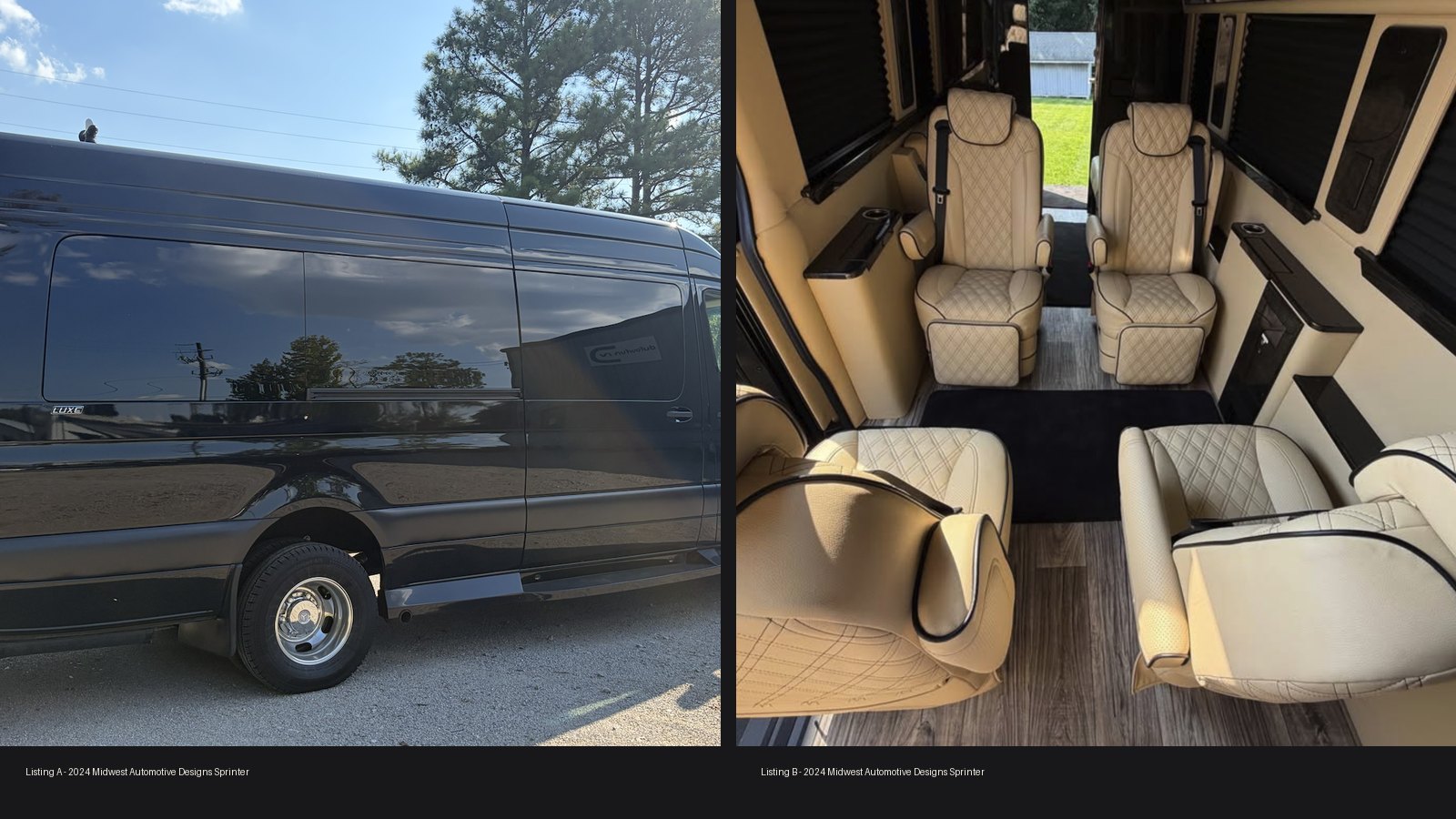
Two of our current Midwest Automotive Designs listings carry a line in the description that sounds contradictory until you know how these vehicles are built: "Midwest manufactured as a 2025, chassis is a 2024."
That is not a typo, and it is not unusual. A luxury van is built in stages by different companies, and those stages happen on different dates. This article explains what the two years mean, which documents settle which question, and what we can and cannot tell you from a listing. Sources checked September 21, 2026.
We are describing listing language and publicly documented federal rules. Nothing here is legal advice, and nothing here is a conclusion about how any state would title or classify a specific vehicle.
Two manufacturers, two dates
Mercedes-Benz builds a chassis. An upfitter — Midwest Automotive Designs, Ultimate Toys, and others — completes the vehicle afterward. Federal regulation recognizes this directly. 49 CFR Part 567 defines an incomplete vehicle manufacturer, an intermediate manufacturer and a final-stage manufacturer, and specifies what each must put on a label.
Under § 567.5, the incomplete vehicle manufacturer's label carries the words "INCOMPLETE VEHICLE MANUFACTURED BY" along with the month and year of manufacture of the incomplete vehicle. The final-stage manufacturer adds its own certification label. If a vehicle was altered after certification rather than completed from an incomplete chassis, § 567.7 sets out the alterer label, which states who altered it and the month and year the alterations were completed.
So a van can legitimately carry a chassis date from one year and a completion date from the next. That is exactly the situation a "2024 chassis, 2025 conversion" listing is describing.
Here is the honest caveat: those labels record dates of manufacture and completion, not the marketing "model year" a seller writes in an ad. The regulations do not resolve how a seller should phrase that in a listing. Two accurate labels can support more than one reasonable-sounding sentence.
What the VIN does and does not settle
The VIN encodes a model year in its tenth character, and the structure is set by 49 CFR Part 565 rather than by a single tidy statutory definition. We looked for a clean federal statutory definition of "model year" applying generally to vehicles and did not find one — the operative mechanics are regulatory.
Two limits are worth knowing:
- The year codes cycle, roughly every thirty years, so the tenth character alone does not distinguish a year from its counterpart a cycle earlier without the plant and manufacturer data around it.
- The data is manufacturer-reported. NHTSA's own VIN decoder states that the information displayed is reported by the manufacturer, directs further questions to the manufacturer, and notes that more information may be available on a label affixed to the vehicle. The underlying vPIC dataset is populated from manufacturers' Part 565 submittals and covers model year 1981 forward.
In plain terms: the free NHTSA decoder is an excellent first check on the chassis, and it will tell you nothing about the conversion. Interior, seating, air-ride upgrades and trim packages are not in that dataset. Those live in upfitter paperwork.
The paperwork behind the chassis date
There is a document class most retail buyers never see. 49 CFR Part 568 requires the incomplete vehicle manufacturer to furnish an Incomplete Vehicle Document with the chassis, and § 568.4 lists its contents: the incomplete manufacturer's name and address, the month and year of its last manufacturing operation, the VIN, and the GVWR and axle ratings for the completed vehicle.
That is the cleanest documentary statement of when the chassis stage ended. Whether a dealer or upfitter retains a copy years later varies; it is a fair thing to ask about, and a shrug is not a red flag by itself.
Warranty start is a third date entirely
Owners often assume warranty runs from the model year. Mercedes-Benz's own Sprinter service and warranty booklets — for example the MY2025 Sprinter warranty and service booklet and the MY2024 booklet — record a field labeled "Warranty Start Date (In-Service Date)" next to the VIN and delivery mileage. The documented term is an in-service date tied to delivery, not the chassis build month.
Be careful what you conclude from that. We looked for an official Mercedes-Benz USA statement about upfitter or body-builder responsibility for conversion work and did not find one we could cite. So: ask the selling dealer for the recorded in-service date, and ask the upfitter directly what its own conversion coverage says. Do not accept anyone's summary of the other party's warranty, including ours.
Recalls follow the stage that caused them
NHTSA operates a self-certification system rather than a pre-approval one — an interpretation letter on multi-stage labeling duties restates that each manufacturer must exercise due care to certify compliance and that NHTSA does not approve vehicles. Read alongside § 567.5, which assigns certification duties and liabilities by stage, the practical result is that a chassis defect notice normally originates with the chassis maker and a body or conversion defect with the final-stage manufacturer or alterer.
We want to be precise: that is reasoning from the regulatory structure, not a quotation from a plain-English NHTSA policy page. We could not find one stating it in those words.
What to actually inspect, in order
- Photograph every label in the driver's door opening. Both manufacturer labels if present, plus the tire and loading placard. Do not assume a second label is a problem.
- Read the dates on each label. The incomplete-vehicle label's month and year; the final-stage or alterer completion month and year.
- Run the VIN through NHTSA's decoder and compare the chassis year and plant against the label and the title.
- Check open recalls by VIN at nhtsa.gov/recalls, and ask separately whether the upfitter has issued any conversion notices.
- Ask for the recorded in-service date and the service history, then compare it with the label dates.
- Ask whether the Incomplete Vehicle Document or upfitter build sheet exists for the vehicle.
- Compare all of it with the title and registration, and ask the seller to explain any year mismatch in writing.
| Question | Where the answer lives |
|---|---|
| Chassis model year | VIN, NHTSA decoder, chassis label |
| When the chassis stage ended | Incomplete-vehicle label; IVD if retained |
| When the conversion finished | Final-stage or alterer label |
| What the conversion includes | Upfitter build sheet — not in vPIC |
| Warranty clock | Recorded in-service date |
| Title year | Certificate of title and state records |
The two listings, described plainly
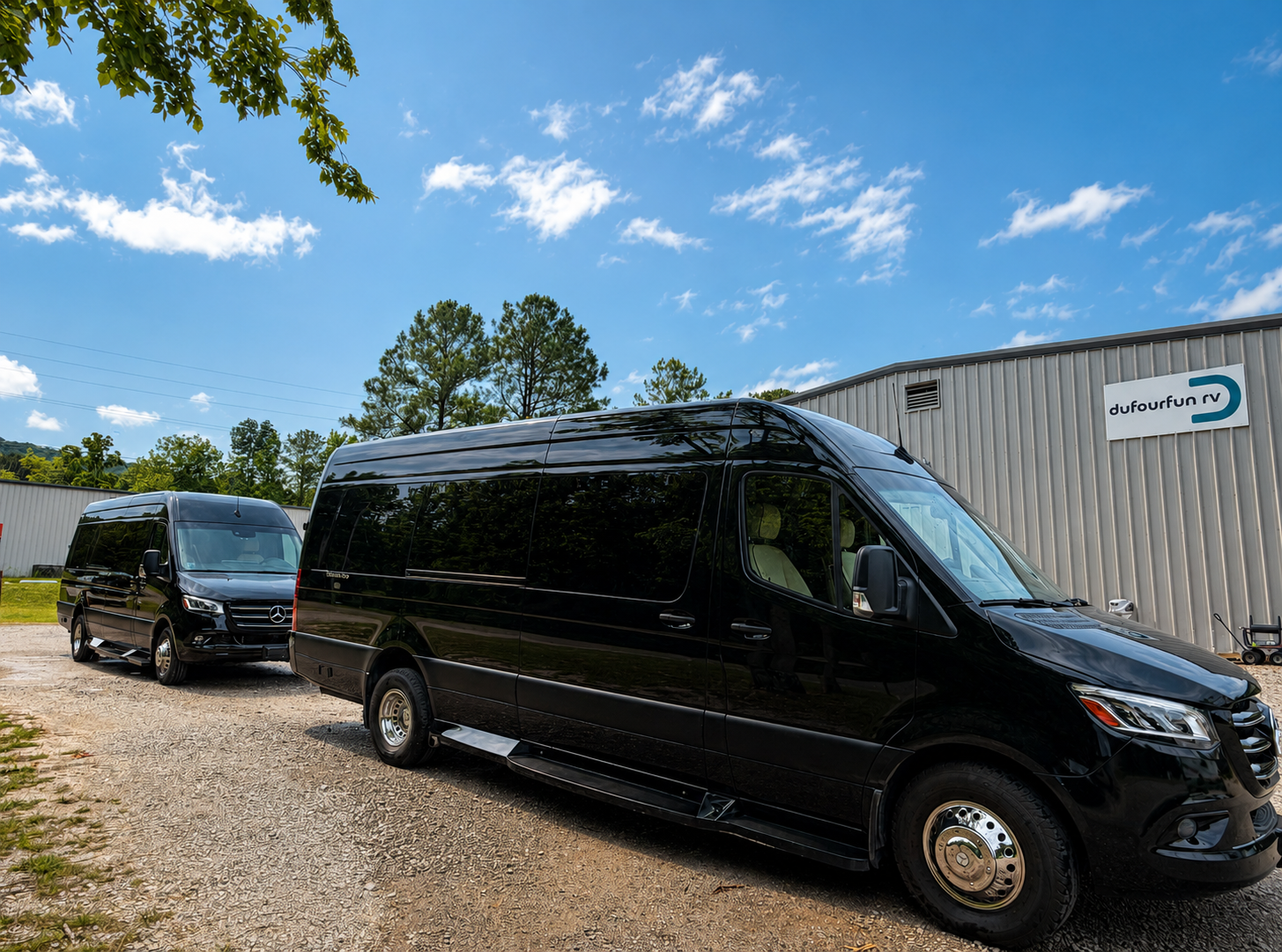
Both of the current Dufourfun listings below are described in our inventory as Midwest Automotive Designs Sprinters with an air-ride suspension upgrade, all-wheel drive, Maybach trim upgrade and upgraded alloy wheels, and both descriptions include the line "Midwest manufactured as a 2025, chassis is a 2024."
- Listing A — listed as a 2024 Midwest Automotive Designs 10-passenger, 14,900 miles, $149,900.
- Listing B — listed as a 2024/25 Midwest Automotive Designs Sprinter, 14,990 miles, $149,700.
Those are the listing facts as published, and prices, mileage and availability change. They are a useful real example of dual-year language, and they are not a legal characterization of either vehicle's model year, title classification or warranty status. Inspect the labels and documents on the specific van, with your own advisor if the answer matters to your financing, insurance or resale plan.
What we honestly cannot tell you from a listing
- Whether a given state's title will read 2024 or 2025. Titling generally traces the VIN and the manufacturer's certificate of origin, but we found no single codified nationwide rule and state practice varies.
- Whether a seller's dual-year phrasing is the "right" way to write it. That is a fact-specific question about listing language, not something Parts 565, 567 and 568 answer.
- What any conversion warranty covers. Ask the upfitter.
None of that is a reason to avoid these vehicles. It is a reason to read two labels instead of one.
Browse our current inventory with these questions in hand, or start a custom build where the chassis year and completion date are documented from the beginning.
Photo credit and adaptation: Hero: Dufourfun-owned listing photography. Left half from listing e5663a46-b59e-403c-b37a-d025178f1d95 (file 5a86ef39-3247-4c1b-bd6b-6e8c585398d2.png); right half from listing 6b76bd5a-0f6e-4d48-b2cb-f0a914bbb363 (file 3e01ad3b-6b2e-4ba1-963a-b522cae2970c.png). Neither source photo was used in a prior blog hero or composite. Adapted by cropping each to fit a two-panel 1600x900 layout with a neutral divider and text labels reading 'Listing A' and 'Listing B'; no retouching or alteration of either vehicle. Two separate vehicles are pictured; the image is not a single-van photograph.
Sources in this article were accessed and checked on September 21, 2026. Rules, prices, mileage and availability change — verify current details directly with the linked source or with us.