
A music-competition weekend can combine a pre-dawn departure, formal clothing, fragile instruments, rehearsal changes and several hours of waiting. A luxury passenger van may solve the routine well—but only if the cases fit without compromising belted seating or exits.
This is a buyer’s use-case guide, not an ownership story. The right layout depends on the exact instruments, passengers and equipment your household carries.
Design around the cases first
Start with the largest case, not the prettiest seat. Measure each case at its widest, tallest and deepest points, including handles and wheels. Then add garment bags, music stands, folding stools, small luggage and the everyday tote that always appears at departure.
A paper plan should include:
| Item | Best test position | Tradeoff to inspect |
|---|---|---|
| Violin or viola case | Secured low, away from a step or door | Easy access can tempt loose placement |
| Cello case | Upright only if the case maker permits and it can be restrained | Tall cases can block sightlines or exits |
| Upright-bass case | Dedicated secured cargo bay or appropriate trailer solution | It can consume an entire passenger aisle |
| Brass or woodwind cases | Low, contained and separated from foot traffic | Multiple small cases shift and become trip hazards |
| Garment bags | Hanging point clear of doors and belts | Long garments may block drawers or switches |
| Music stands and stools | Strapped bin or dedicated compartment | Loose metal equipment can move sharply in a stop |
Do not assume a sofa, overhead shelf or open aisle is a cargo restraint. NHTSA’s secure-your-load guidance recommends tying cargo down and checking it again before travel.
1. Protect every travel seat
Every passenger should have an appropriate travel position and restraint. NHTSA says to buckle up every trip, including in the back seat, and explains proper belt positioning in its seat-belt safety guidance.
When inspecting a conversion:
- identify every seat certified for travel;
- buckle each belt with the intended passenger seated;
- check whether a case interferes with the latch or shoulder belt;
- keep aisles and doors clear;
- confirm child-restraint compatibility for the exact seat and child;
- distinguish a parked lounge position from a safe travel position.
A swivel seat may face the conversation area while parked. Confirm the manufacturer’s travel-position instructions before driving.
2. Treat climate stability as instrument care
Wooden instruments react to rapid temperature and humidity changes. Yamaha’s violin care guide says violins should be stored in their cases and in conditions with stable temperature and humidity. Yamaha’s winter-care guidance also advises against leaving a string instrument in the cold and recommends allowing it to warm gradually in its case.
That does not turn the van into a climate-controlled vault. It means the buyer should test:
- rear heat and air conditioning from a cold start;
- temperature difference between the passenger cabin and cargo area;
- direct sun on case locations;
- airflow that blows directly on a delicate instrument;
- how climate is maintained during stops;
- whether the van can be plugged in or safely stored between trips.
Editorial recommendation: never make an instrument’s safety depend on leaving it unattended in a parked vehicle. Follow the instrument and case maker’s instructions, and bring valuable instruments indoors when practical.
3. Weigh the completed van, people and cases
A base-vehicle payload number is not the completed conversion’s remaining capacity. Mercedes-Benz’s Sprinter Body and Equipment Guidelines explain that payload after upfit must account for permanently installed equipment, while GVWR includes the finished vehicle, occupants and cargo.
Ask for the completed-vehicle labels and weigh the van in realistic trim:
- normal fuel level;
- driver and regular passengers;
- instrument cases;
- luggage and garment bags;
- water and onboard supplies;
- any hitch-mounted carrier or trailer tongue weight.
Record front axle, rear axle and total weight. Staying below total GVWR is not enough if one axle is overloaded.
4. Run a full rehearsal-day test
Do not test an empty showroom. Recreate the busiest 20 minutes of the day.
- Load the largest instrument first.
- Add every passenger and buckle every belt.
- Close all doors without pressing cases against trim or hardware.
- Retrieve one instrument without unloading the entire van.
- Change shoes and reach a garment bag.
- Drive over normal city pavement and listen for movement.
- Park in a standard space and open the loading door safely.
- Reverse the process after dark.
If a case has to occupy an aisle, a passenger seat or an unrestrained sofa, the layout is wrong for the use.
5. Choose between passenger priority and instrument priority
An open social cabin favors conversation but may sacrifice a protected cargo bay. A rear restroom can be valuable on long days, yet it removes space that might otherwise hold a cello or luggage. A partition creates privacy but may reduce communication with the driver. A longer body can add room, but it also changes parking and maneuvering.
| Layout priority | Best for | Watch for |
|---|---|---|
| More captain’s chairs | Individual comfort and frequent adult passengers | Less continuous cargo space |
| Rear cargo compartment | Large cases and garment bags | Confirm ventilation and secure anchor points |
| Rear restroom/galley | Long travel days and venue waits | Payload, winterization and reduced case volume |
| Open rear lounge | Conversation and flexible parked use | Cases may compete with sofa and aisle space |
| Driver partition | Hired-driver privacy | Communication, rear visibility and emergency access |
6. Separate travel convenience from performance needs
The van can reduce friction between home, hotel and venue. It cannot replace correct instrument handling, venue rules or professional repair advice. Keep a simple checklist in the cabin:
- instrument count;
- bow and accessory count;
- music folder/tablet;
- garment and shoes;
- charger and backup battery;
- humidity monitor if recommended by the case maker;
- water and snacks stored away from instruments;
- final secure-load check.
A repeated routine is the ownership advantage: the straps, bins, charging cables and garment storage can stay assigned instead of being rebuilt for every weekend.
When ownership makes sense
Editorial recommendation: ownership becomes easier to justify when music travel is one of several recurring uses—school or conservatory runs, auditions, family trips, airport transfers and other competitions. Count the real days, not the imagined ones.
If the same cases and passengers travel often, a purpose-tested van can make the routine more predictable. If the group composition changes constantly or the largest instrument travels only once a year, a permanent layout may be too specialized.
The bottom line
Buy the van that protects the people first, secures the cases second and still works for the household’s other travel. A beautiful cabin that cannot carry the actual instruments safely is not the right build.
Use View Vans for Sale to inspect current layouts. If the required case bay, seat count or storage system is not available, continue with Build Your Custom Van.
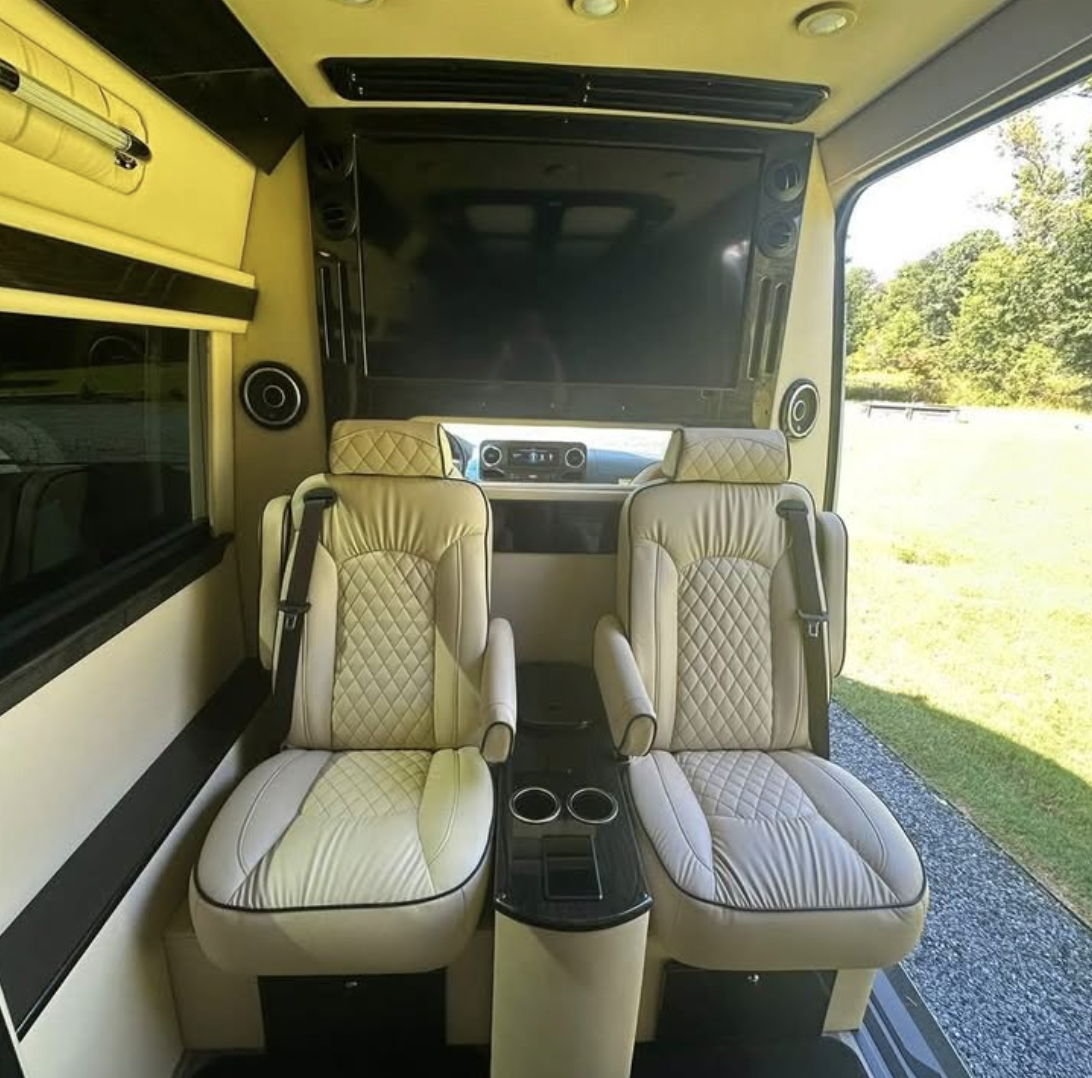
Hero image note: Dufourfun Vans business-owned inventory photography of the exact current 2023 Executive Coach listing. Original listing source: 2023 Executive Coach. Original stored image: d5a04a33-f684-4964-9b4e-d843fe2abef8.png. Creator credit was not recorded in the inventory system; commercial use is based on the business-owned listing asset. The photo illustrates individual passenger seating and does not depict instruments or a specific music event.