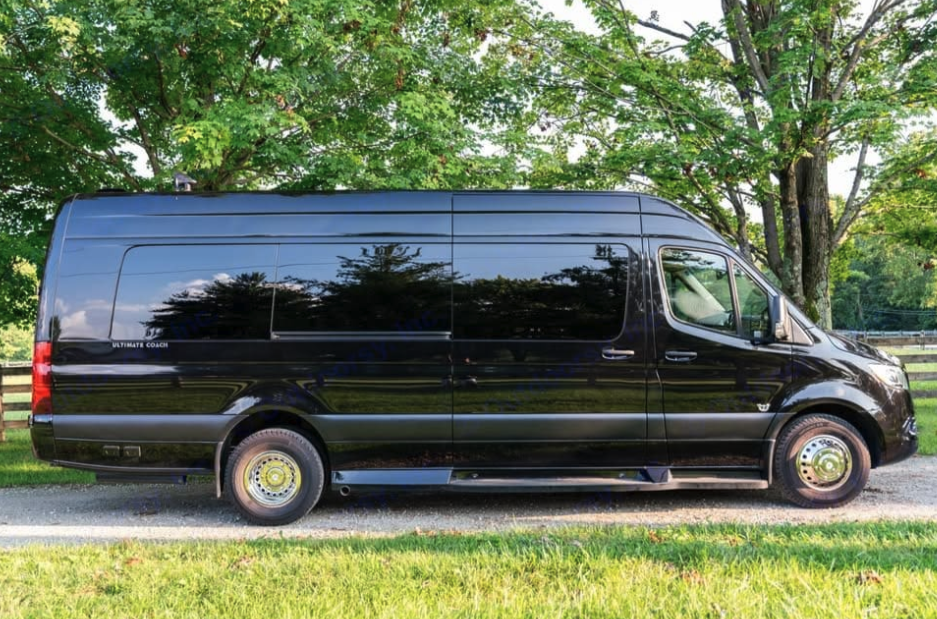

Most privately used luxury vans with fewer than 16 designed seating positions do not trigger the federal passenger-capacity CDL threshold. That short answer is useful—but incomplete.
The correct answer depends on the vehicle’s designed capacity, weight, how it is used, whether passengers are carried for compensation and the rules of the driver’s state. Removing a seat after purchase is not a reliable way to change how regulators classify a vehicle.
This guide summarizes the federal starting point, not state-specific legal advice.
The federal 16-person threshold
Under the federal CDL definitions in 49 CFR 383.5, a vehicle used in commerce can fall into Group C when it is designed to transport 16 or more passengers, including the driver, even if it is below the heavy-vehicle weight thresholds.
Count people, not rows: “16 including the driver” means the driver plus 15 passengers.
A driver who operates a qualifying commercial passenger vehicle needs the appropriate CDL class and passenger endorsement. 49 CFR 383.93 says the passenger endorsement requires both knowledge and skills testing.
A quick screening table
| Van scenario | Federal CDL screening result | What to verify next |
|---|---|---|
| Private family use, under 16 designed occupants | Federal passenger-capacity CDL threshold generally is not triggered | State license, registration and insurance rules |
| Business use, under 16 designed occupants | May avoid the federal CDL passenger threshold, but other commercial rules can still apply | Compensation, interstate operation, GVWR, DOT registration and state rules |
| Designed for 16 or more including driver and used in commerce | Federal Group C passenger rule may apply | CDL class, passenger endorsement and operating requirements |
| GVWR or combination rating at/above federal weight thresholds | CDL may apply regardless of having fewer seats | Certification label, actual use and towing setup |
| School transportation or hazardous materials | Separate rules may apply | Obtain specialist compliance advice |
This table is a screening tool. Do not use it as the final answer for a fleet, charter, hotel shuttle, church, school or paid transportation operation.
“Private” and “commercial” are not the same question
A luxury Sprinter used only by its owner’s family presents a different regulatory profile from the same van used for paid airport transfers, executive transportation or a hotel shuttle.
The federal CDL definition applies to a motor vehicle used in commerce and then looks at weight, designed passenger capacity and hazardous-material use. Commercial motor-carrier rules can also reach some passenger operations below the CDL threshold. The FMCSA driver guidance is a useful federal starting point, but operators must also check state and local requirements.
Do not assume “no CDL” means “no commercial regulation.” DOT registration, operating authority, insurance limits, driver qualification, hours-of-service or inspection rules may apply depending on the operation.
Designed capacity matters more than today’s headcount
The federal language says “designed to transport,” not “currently carrying.” A 16-person vehicle does not necessarily become a non-CDL vehicle because only six people are aboard.
For a conversion, compare:
- the federal certification and final-stage labels;
- the original seating plan and conversion invoice;
- the number of permanently installed, designated belted positions;
- the title and registration classification;
- the GVWR and GAWR;
- any records for seats added or removed.
Our guide to luxury van conversion certification labels explains where those records fit together.
Why weight can change the answer
Even with fewer than 16 designed occupants, a vehicle or combination used in commerce can meet federal CDL definitions through weight. The federal rule uses 26,001 pounds as a key threshold for Group A and B configurations, with additional conditions for a towed unit in Group A.
Most luxury passenger-van buyers will be below that threshold, but never guess. Read the permanent GVWR label and include the trailer when analyzing a commercial combination. For chassis context, compare Sprinter 2500 and 3500XD luxury vans.
What to do before buying for business use
If you plan to carry clients, guests or employees, write down the proposed operation before shopping:
- How many people is the van designed to transport, including the driver?
- Will any passenger pay directly or indirectly?
- Will the van cross state lines or serve an airport?
- What are the vehicle’s GVWR and any trailer’s GVWR?
- Who will own the van and employ the driver?
- Where will it be registered and primarily operated?
- Is it a hotel, church, school, entertainment, medical or government use?
Send that fact pattern and the vehicle’s VIN/label photos to your state driver-licensing agency, insurance broker and—if the operation may be interstate or for-hire—the appropriate motor-carrier regulator. Get the classification and insurance answer in writing before closing.
Safety does not stop at licensing
Large passenger vans handle differently when loaded. NHTSA maintains specific 15-passenger van safety guidance, including attention to tire condition, trained drivers and passenger loading.
A legal license is the minimum. A business should also establish driver training, pre-trip tire checks, seating and belt rules, maintenance records and a no-distraction policy.
Bottom line
For a typical privately used luxury van designed for fewer than 16 occupants, the federal passenger-capacity CDL rule generally is not the obstacle buyers fear. Commercial use, a 16-person design capacity, heavy ratings, towing or special transportation can change the answer.
Verify the exact van and intended use before purchase. When you are ready to compare documented seating layouts, browse Dufourfun Vans’ current luxury vans for sale and ask for the label and equipment details for the specific vehicle.