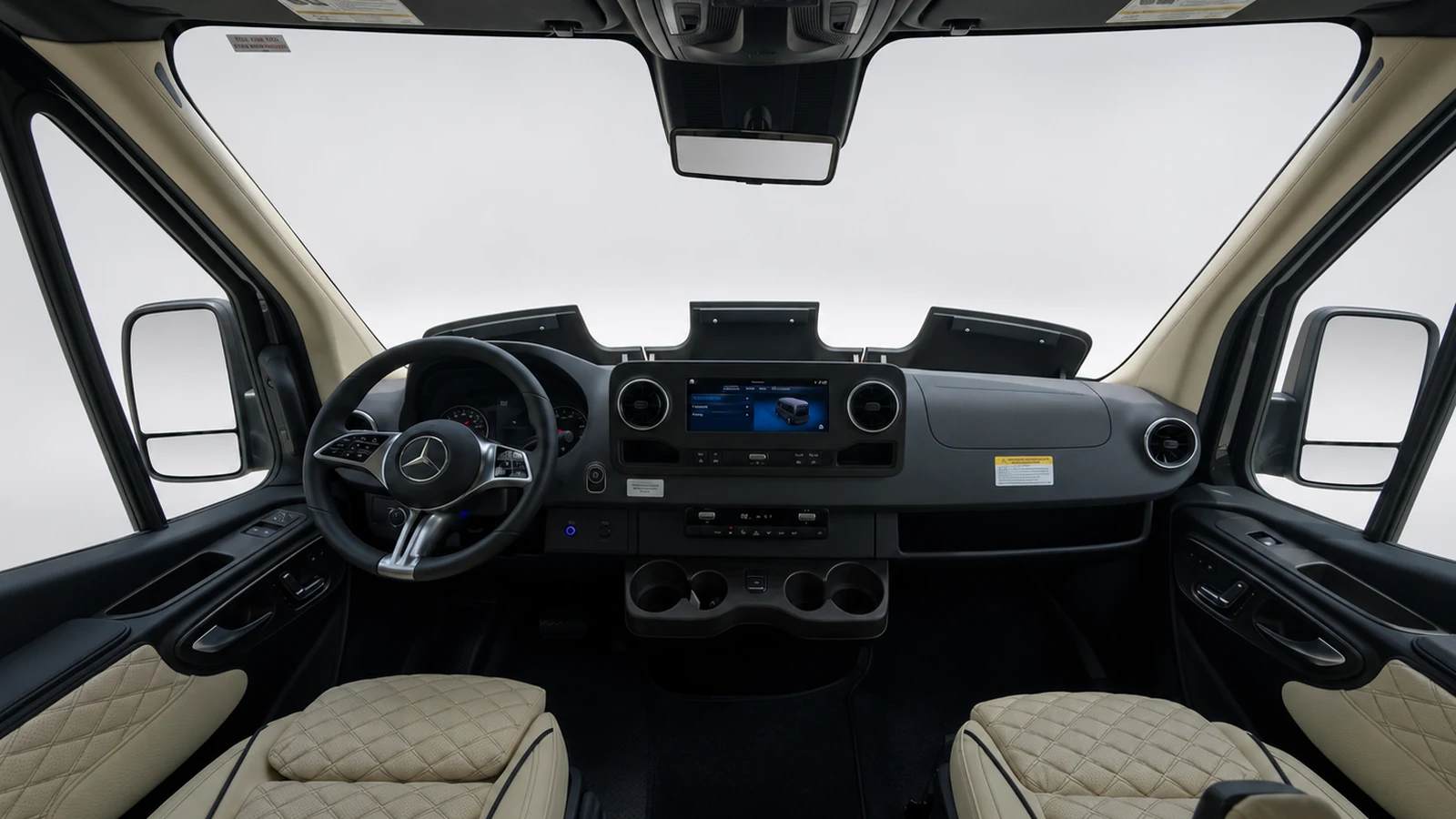
Illustrative Dufourfun inventory photo of a Sprinter driver cockpit. It shows neither refueling nor a DEF refill, and the pictured screen is not evidence of another van's menus or equipment.
A diesel luxury passenger van can serve several drivers, but its routine should not live in one person's memory. Fuel and diesel exhaust fluid, usually called DEF, are separate fluids with different purposes. Before buying, decide who checks them, where the exact vehicle instructions live and how a warning message gets handled when the usual driver is away.
Diesel fuel and DEF do different jobs
Diesel is the fuel used by the engine. DEF is a separate fluid used by the emissions system, not something to pour into the fuel tank. The EPA's DEF overview explains its role in diesel emissions control. That general guidance does not establish a procedure, capacity or refill interval for a particular Mercedes-Benz vehicle.
For the vehicle, the primary reference is the manual that matches its model year and equipment. Mercedes-Benz provides an owner-manual portal. The seller and upfitter may also have instructions for the conversion, but those should complement rather than replace the chassis manual.
A 2025 Sprinter manual example, not a universal menu map
The 2025 Sprinter Operator's Manual provides a useful model-year example. It describes checking the DEF level through the Service menu under Additive (DEF). It also gives these refill-related precautions:
- Switch the vehicle off before topping up.
- Never put DEF in the fuel tank.
- Do not overfill.
- Close a refill container after use.
- Avoid permanently carrying DEF refill containers.
These points should not be generalized into a claim that every model year uses the same screen path or equipment. Follow the manual for your own VIN and model year, along with applicable seller and upfitter instructions. If a demonstration van differs from the manual example, ask for the correct instructions before relying on it.
Build the routine before the first shared trip
A simple handoff plan prevents two common failures: everyone assuming someone else checked, and one person improvising when a message appears. Write the routine in plain language and keep it with the vehicle documents.
| Role | Routine responsibility | Handoff detail to record |
|---|---|---|
| Current driver | Reviews the exact vehicle's pre-trip routine and responds to messages as the manual directs | Any warning, unusual condition or service already planned |
| Primary owner or fleet lead | Keeps the correct manual and service contacts available | VIN, model year and where current documents are stored |
| Spouse, assistant or backup driver | Knows where instructions are and who to call | Confirmation that the normal checks were completed |
| Record keeper | Files fuel receipts and service records consistently | Date, odometer, vendor and any related service note |
One person can hold several roles. The point is explicit responsibility, not organizational complexity.
A practical pre-road-trip check
- Use the exact manual. Confirm the VIN, model year and current instructions instead of relying on a remembered screen path from another Sprinter.
- Ask the usual driver about recent messages. A handoff should include warnings, service appointments and anything that felt different, without diagnosing it informally.
- Check levels only as the vehicle instructions describe. In the 2025 example, the DEF level appears through Service and Additive (DEF). Other vehicles may differ.
- Keep fuel and DEF clearly separated. Never use the fuel tank for DEF. If anyone is unsure about a filler or fluid, stop and consult the correct documentation or a qualified service provider.
- Review packing and refill-container instructions. The 2025 manual says to close a refill container after use and to avoid permanently carrying DEF refill containers. Do not invent a different storage practice for a family or staff vehicle.
- Confirm service contacts before departure. A passenger trip is not the time to search through old messages for the seller, chassis service provider or upfitter.
Respond to a warning without guessing
A dashboard message is a reason to read the exact manual instructions, not a prompt for a universal internet fix. Note the wording, when it appeared and any accompanying indication. Follow the manual's direction about continuing, stopping or obtaining service. Do not keep driving simply because another driver remembers a different message on another vehicle.
Also avoid treating a refill as proof that every underlying issue is resolved. If the manual calls for service, arrange it. If the message or vehicle behavior is unclear, contact a qualified provider. EPA general information is useful background, but it does not change the operating procedure for a specific Mercedes-Benz without manufacturer confirmation.
Keep receipts and service records useful
A consistent record habit is more valuable than a pile of paper. For fuel receipts, retain the date, location, amount purchased and odometer when available. For service, keep the invoice, reported concern, work performed and provider. Add DEF-related service to the same file when it appears on an invoice.
These records can help a future driver understand what happened and help a buyer review history. They do not establish a universal refill interval, fuel economy, tank capacity or maintenance cost. Avoid deriving promises from a handful of trips with different loads, routes and driving conditions.
What to verify before buying the exact van
- Identity and documentation: Match the VIN and model year to the correct manual and service file.
- Demonstrated controls: Ask the seller to show the relevant display and explain it using the manual, without assuming every screen is identical.
- Filler identification: Have the correct fillers pointed out and read the labels. Never experiment with fluids.
- Chassis and conversion responsibilities: Clarify which provider handles chassis emissions equipment and which handles upfit-related work. The article on Mercedes-Benz and upfitter service responsibilities offers a broader checklist.
- History and current condition: Review available records and ask about existing warnings or emissions-related repairs. Consider an independent inspection appropriate to the vehicle.
- A realistic handoff: Have the spouse, staff member or backup driver who will actually use the van practice finding the documents and explaining the response plan.
Buyers comparing older diesel vehicles can also read the existing DEF and DPF used-buyer guide. For current options, browse vans for sale, or describe a shared-driver ownership plan in the custom van builder. Any equipment and procedure still need confirmation for the exact vehicle.
The goal is not to make every driver a technician. It is to make the next correct action clear: use the right fluid, consult the right manual, record what happened and involve the right service provider.
Image credit
Original stored source: OGV V-Cruise driver-cockpit inventory photo. Creator: Dufourfun Vans, with no named photographer documented. Usage basis: business-owned inventory image in the site-controlled Dufourfun media library. Transformation: EXIF orientation normalized; crop rectangle [0, 135, 1449, 950] from 1449 by 1086 pixels; Lanczos resize to 1600 by 900; WebP quality 88. The resize involved a modest upscale. No generative editing or vehicle alteration. This is an illustrative cockpit photo. It does not show a fuel or DEF action and does not establish another vehicle's menus, equipment or service procedure.