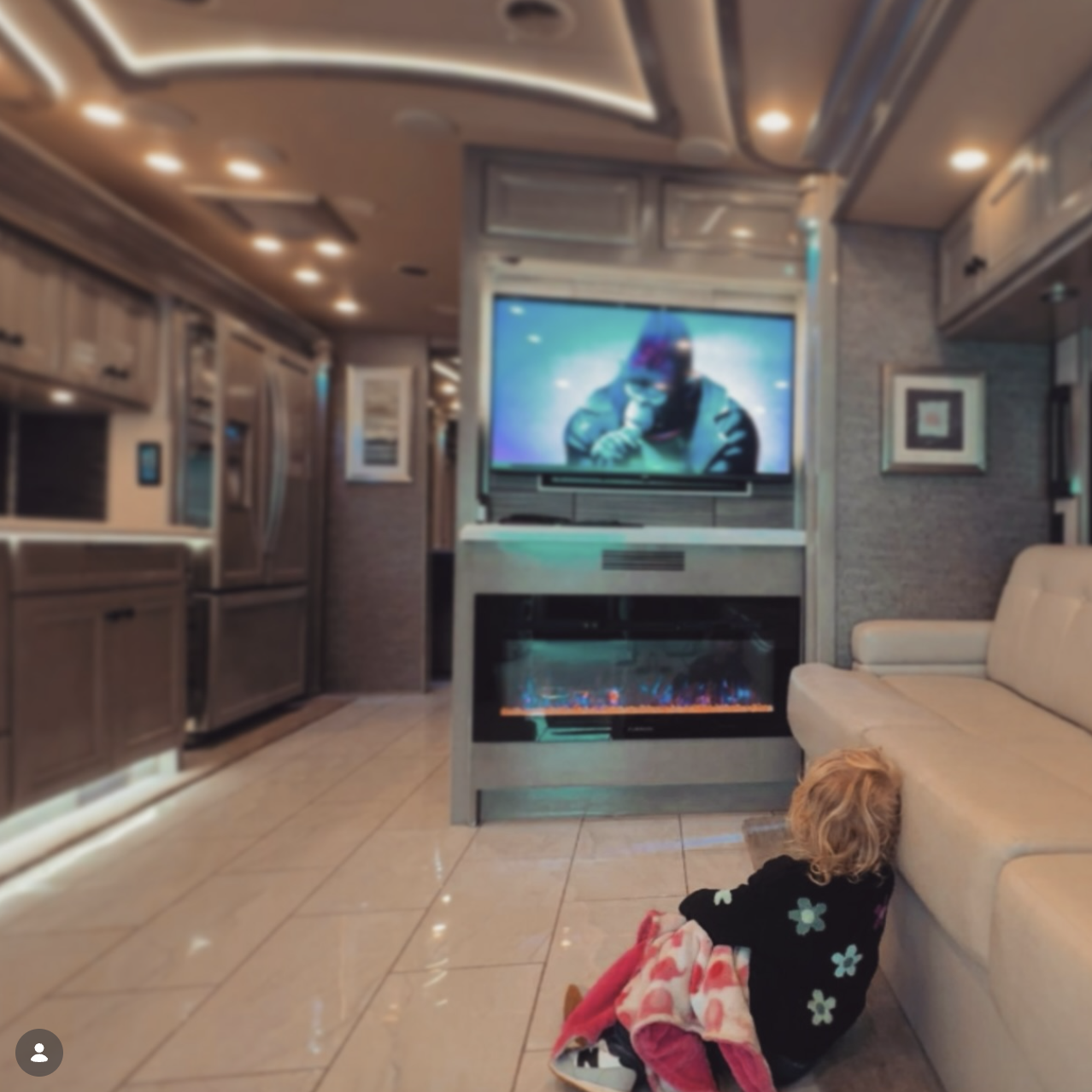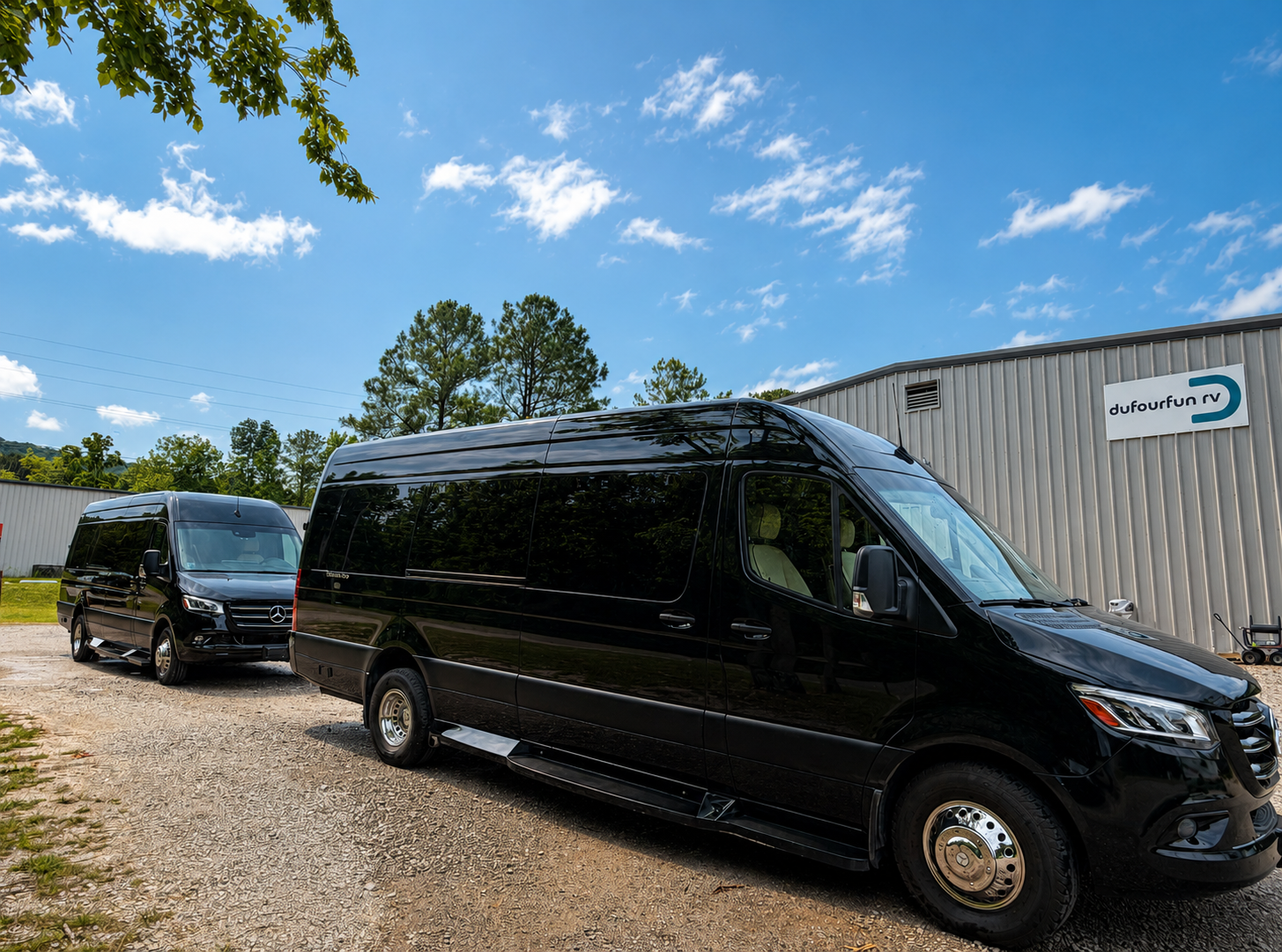
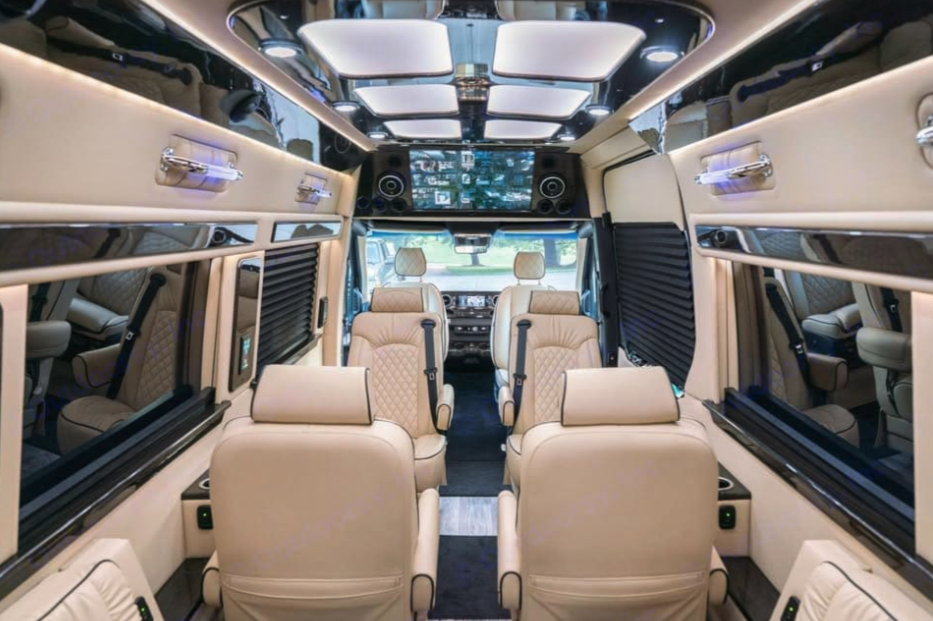
A luxury van can feel wonderfully cool during a test drive and still be the wrong vehicle for a long parked lunch or a sports tournament. The buying question is not simply whether it has air-conditioning. It is which cooling system works while parked, what powers it, and for how long.
This guide reflects manufacturer information checked September 6, 2026. The cabin photo is an existing Dufourfun site image, not proof of a particular A/C or battery specification.
Start with the power source, not the thermostat
Ask the seller to identify every installed air-conditioner and explain how each operates. A separate rear control panel is not proof that cooling works with the engine off.
A useful example appears in the current Ultimate RV specifications: Ultimate Toys lists a lithium house battery and an inverter, but identifies the rooftop A/C as a shore-line unit. That combination should prompt a wiring and equipment check, not an assumption of battery-powered cooling. Ultimate RV specifications
Use this checklist at the viewing:
| Advertised feature | What you still need to confirm |
|---|---|
| Rear air-conditioning | Does it require the vehicle engine to run? |
| Rooftop A/C | Which power sources can operate this exact unit? |
| Lithium house battery | Does it power the A/C, or only other cabin equipment? |
| Inverter | Is the A/C connected to it, and is its capacity adequate? |
| Shore-power connection | What electrical supply and approved connection equipment are required? |
| Generator, if fitted | Can it run the cooling system, and where is operation permitted? |
Have the seller demonstrate normal operation using the manufacturer's instructions. This is a purchase check, not a reason to bypass breakers, change wiring or improvise a power connection.
Compare energy capacity in watt-hours
Amp-hours alone are a poor basis for comparing systems at different voltages. Nominal watt-hours equal nominal volts multiplied by amp-hours. Battery manufacturer Battle Born explains this conversion in its amp-hour to kilowatt-hour guide.
For illustration, a hypothetical 200Ah bank at 12.8V stores 2,560Wh of nominal energy. A 200Ah bank at 25.6V stores 5,120Wh. These are arithmetic examples, not specifications for any van listed here.
Nominal energy is not the same as energy available for your afternoon stop. Ask about the permitted discharge range, battery condition, protective shutdown settings and the reserve needed for other equipment.
Treat published runtime as a claim to verify
Grech's article describing its 2026 power system lists 16,896Wh and advertises A/C operation for up to 14 hours without shore power. That is a manufacturer claim for the described package, not a universal luxury-Sprinter benchmark or an independent test. Grech Power overview
Ask what temperature, thermostat setting, starting charge and other loads were used to establish any quoted runtime. A van cooling down after sitting in direct sun presents a different task from maintaining an already cool cabin.
A simple planning estimate is:
Runtime in hours ≈ usable energy in Wh ÷ average battery draw in W.
For example, 4,000Wh available for the stop divided by an assumed average total battery draw of 1,000W gives four hours. At 1,500W, the same allowance gives about 2.7 hours. Those assumptions are illustrative; they are not a forecast for a particular A/C.
Using total battery draw helps account for other equipment and conversion losses. Victron's battery-monitor documentation explains current, power and consumed-capacity readings.
Request a parked-cooling demonstration
Our recommended viewing procedure is to ask the seller to:
- Record the starting battery charge, outside conditions and cabin temperature.
- Disconnect shore power safely and turn the vehicle engine off, following the operating instructions.
- Start the supported parked-cooling system and show that it is actually cooling, not just blowing air.
- Run the refrigerator, lighting and other equipment you expect to use.
- Record elapsed time, cabin temperature and battery draw or charge change.
A brief demonstration can expose a mistaken claim about engine-off operation. It cannot prove overnight endurance. If several hours of cooling are essential, make a representative longer test part of your evaluation.
Check how you will recharge
A battery can solve one stop and still leave you short for the next. Ask how the van charges from driving and shore power, and what recharge time the seller expects under your actual usage.
Describe a realistic day: drive to the venue, park for several hours, make a short dinner trip, then park again. Ask for an energy plan for that sequence, not just a maximum runtime figure. Also request operating guidance for cold-weather charging and any restrictions on idling or generator use.
Buy demonstrated capability
Do not leave children or pets unattended in a van in reliance on an A/C runtime claim. Equipment and power supplies can fail.
For a used candidate, combine the cooling demonstration with our luxury Sprinter inspection checklist. Then browse luxury vans for sale and describe how long you expect to remain parked without a hookup. The right system is the one that demonstrably supports that use, with a practical reserve and recharge plan.