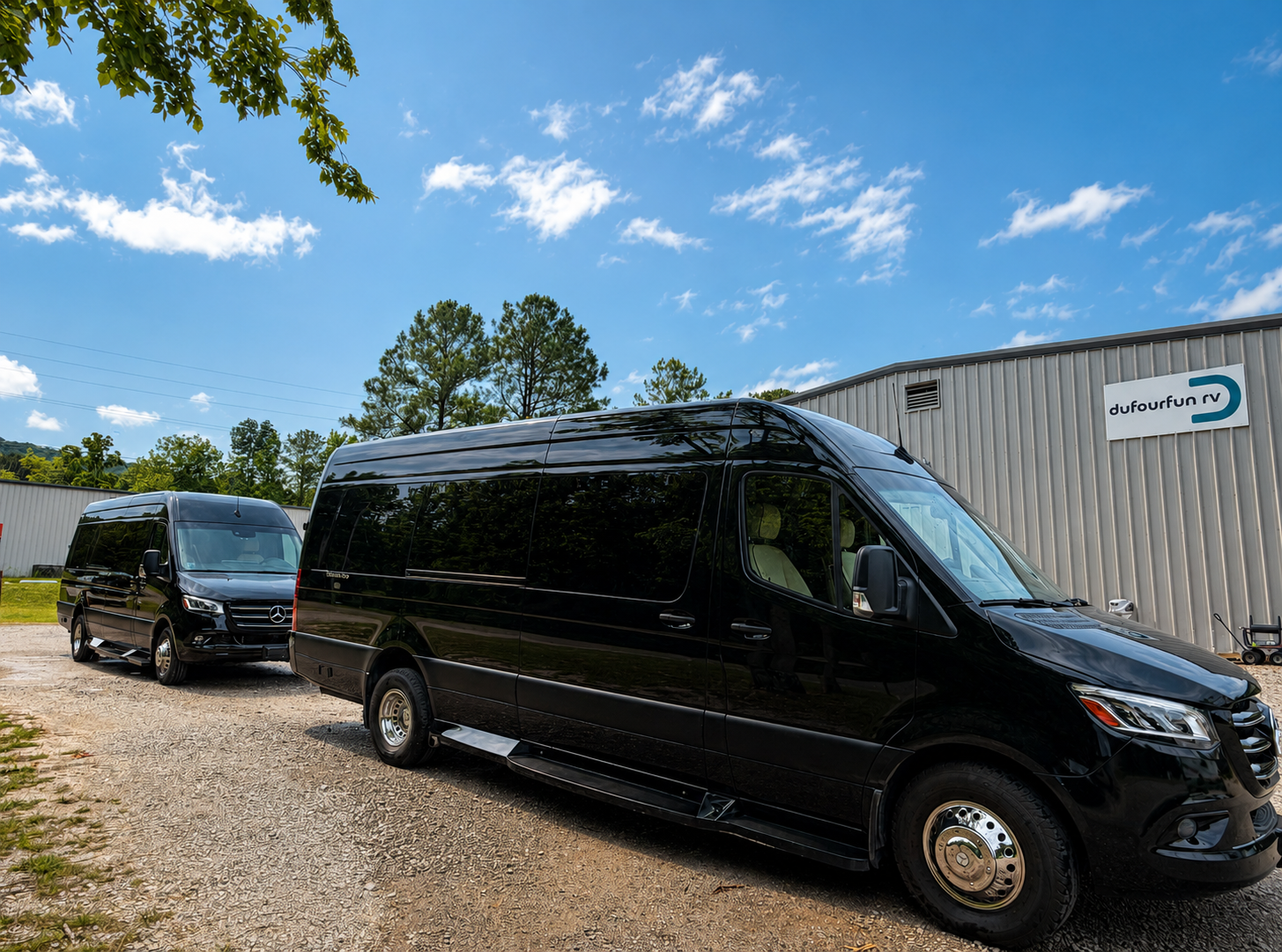

An onboard generator and a large lithium battery bank solve the same basic problem in different ways: they provide electricity when a luxury Sprinter is not connected to shore power. The difference becomes important when you want to run air conditioning, televisions, a refrigerator, chargers or a microwave while parked.
A generator creates power as it runs. A lithium system stores power that must later be replaced. Some luxury vans have one or the other; some have both. The best choice depends on your climate, overnight habits, tolerance for noise and maintenance, and the van’s actual charging system.
Quick comparison
| Buyer question | Onboard generator | Large lithium system |
|---|---|---|
| Sound while operating | Engine and exhaust noise | Nearly silent at the battery |
| Local operating restrictions | May be limited by campground rules or quiet hours | Usually easier to use where generators are restricted |
| Energy supply | Continues while fuel and operating limits allow | Ends when usable stored energy is depleted |
| Replenishment | Fuel plus generator maintenance | Alternator, shore power, solar or another charger |
| Routine maintenance | Engine oil, filters, exercise and fuel-system care | Battery, inverter, charger and monitoring checks |
| Best fit | Long stationary loads with access to fuel and permission to run it | Quiet stops, short overnight loads and frequent driving or shore charging |
| Main used-van risk | Low hours, neglected exercise or fuel-system problems | Unclear capacity, aging batteries or inadequate recharge rate |
This table describes the general tradeoff. The exact equipment and installation matter more than the category.
What a generator gives you
An RV generator is a small engine-driven power plant built into the vehicle. For context, the current Cummins Onan QG 2800i product page describes a gasoline inverter generator intended for motorhome and RV applications. Cummins lists 60 Hz output and EPA Tier 3 certification for that model.
A generator can support sustained electrical loads without requiring an enormous battery bank. That makes it attractive when a van will sit in hot weather and needs extended A/C operation. It can also provide a separate source when shore power is unavailable.
The tradeoffs are real:
- It creates sound, vibration and exhaust.
- It consumes fuel.
- It needs maintenance and periodic operation.
- Some campgrounds, events and neighborhoods restrict when it can run.
- The installation adds weight and occupies space.
- Exhaust routing and carbon-monoxide protection must be treated seriously.
A seller should demonstrate the generator from a cold start, under load. Turn on the largest expected loads one at a time and confirm stable operation. Review the exact model’s service records and Cummins RV generator manuals, rather than applying a generic schedule.
What a large lithium system gives you
Lithium batteries operate without a small combustion engine running beside the van. That makes them appealing for quiet overnight stops and passenger-focused use. They can power electronics instantly through an inverter, and they can recharge from shore power, the vehicle alternator, solar or a combination.
Capacity must be compared in watt-hours, not by the word “lithium.” A 200Ah battery at about 12 volts stores roughly 2,400Wh nominal. A 200Ah system at about 48 volts stores roughly 9,600Wh nominal. Usable energy can be lower after reserve limits, conversion losses, temperature effects and battery aging.
Current manufacturer systems show how wide the range can be. Grech’s current Power MAX versus Power CORE comparison lists 20,480Wh for Power MAX and 10,240Wh for Power CORE. Grech advertises up to 16 and eight hours of rooftop A/C respectively. Those are manufacturer claims under its conditions, so buyers should test the exact vehicle and expect weather, settings and other loads to change runtime.
Battery size is only half the system
A large battery that recharges slowly can still leave you without power on the second night. Ask for the rated output of every charging source:
- Alternator or secondary alternator charging
- Shore-power charger
- Solar array and controller
- Generator charging, if both systems are installed
- Maximum charge rate allowed by the battery-management system
Then estimate recovery time. If you use 8,000Wh overnight and the system replaces only 2,000Wh during the next drive, the large nameplate capacity does not solve the daily energy deficit.
The inverter rating matters too. It must support the starting and running demands of the connected equipment. Ask the seller to demonstrate the roof A/C, microwave and outlets in the way you plan to use them. Do not assume they can all run together.
A battery monitor can be wrong
A display showing 100% does not prove the batteries are healthy or full. Battery monitors estimate state of charge from measured current and configured settings. If the capacity, charged voltage or synchronization settings are wrong, the displayed percentage can be misleading.
The official Victron SmartShunt operating guidance explains how state of charge and synchronization work on one widely used monitoring platform. Other systems have their own procedures.
For a used van, ask for:
- Battery manufacturer, model, voltage and quantity
- Installation date and warranty documents
- Monitor screenshots after a full charge and a meaningful load test
- Fault, high-temperature and low-voltage history
- The upfitter’s wiring diagram and fuse locations
- Confirmation that the charging profile matches the battery
A qualified RV electrical technician can test more than the dashboard percentage.
When both systems make sense
A generator plus lithium can offer quiet battery operation for normal stops and a separate source for longer loads or low state of charge. The current Ultimate RV specifications list lithium battery, inverter, generator and shore-power equipment in the same model, illustrating that combined approach.
The cost is added weight, space and complexity. You are maintaining two power systems and the equipment connecting them. Verify how the generator charges the battery, whether automatic generator start is installed, and which loads bypass or depend on the inverter.
Do not assume every Ultimate RV, or any used luxury van, matches the current page. Model years and options vary.
Choose by use case
A generator deserves serious consideration if you expect long stationary periods, frequent high electrical loads and access to places where it may operate. A large lithium system is attractive if quiet operation matters, your stops are shorter, and driving or shore power regularly restores the battery.
A combined system can fit buyers who want redundancy, provided the payload and maintenance tradeoff works. A passenger van used mainly for day travel may need far less house power than a Class B RV used for hot-weather camping. Our luxury passenger van versus Class B RV guide explains that larger decision.
The pre-purchase test
Test the van disconnected from shore power. Start with a documented state of charge and operate the loads you care about. Record battery percentage, voltage and power draw at the start and after at least 30 minutes. If equipped, start the generator cold, let it stabilize and add loads.
Then verify:
- No electrical or generator fault codes
- Correct transfer between shore, battery and generator
- Working carbon-monoxide and smoke alarms
- Secure batteries, cables and protective covers
- No overheated terminals, damaged insulation or improvised wiring
- Charging from each advertised source
- Service access and replacement-parts availability
- Remaining vehicle payload after the power equipment and passengers
Our parked A/C buyer guide covers runtime questions in more detail, while the used luxury Sprinter inspection checklist helps you evaluate the rest of the vehicle.
When you are ready to compare actual configurations, browse luxury vans for sale at Dufourfun Vans. Ask for the build sheet and power-system demonstration for the exact van you are considering.